
I spent years cooking dinner for the loneliest, meanest 80-year-old man on my street — when he passed away, his will left me and his 3 children SPEECHLESS.
I am 45, a single mother of seven children, and for seven years I cooked dinner for Arthur, the meanest old man on our street.
He lived alone in a peeling white house three doors down. Newspapers piled up on his porch, and no one ever visited. He yelled at my children when they rode their bikes too close to his fence, called them “wild animals,” and told the neighbors I was raising troublemakers.
When I waved at him, he turned away and slammed the door.

So everyone thought I was crazy when I started bringing him dinner.
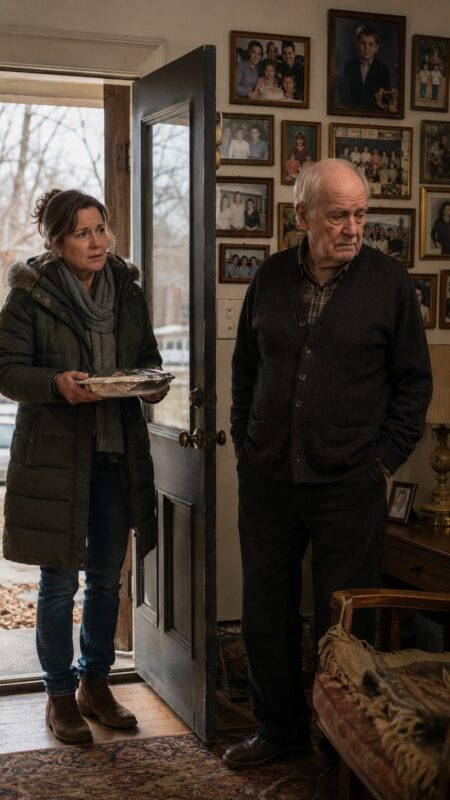
But I remembered the morning I found him collapsed on the icy sidewalk, too proud to ask for help. His hands were shaking when I helped him stand, and when we reached his door, he looked at me with tired, guarded eyes.
“Why would you help me?” he whispered. “I don’t deserve it.”
I touched his shoulder and said, “No one deserves to be left alone.”
That was when I understood. Behind all his anger was a lonely man who had forgotten what kindness felt like.
My own life was not easy. My ex-husband had left me with bills, broken promises, and seven children to raise alone. I worked three jobs and often stretched soup with water just to make sure every child had enough.
Still, I always made one extra plate.
Arthur never thanked me. He only scowled and said, “I didn’t ask for charity.”
But every morning, the plate was empty.
One day, he left the door open, and I stepped inside for the first time. His walls were covered with photographs — children, birthdays, smiles from another life.
“Your family?” I asked.
He looked away.
“Had three kids,” he muttered. “They stopped coming.”
No visits. No calls. Not even on birthdays.
For seven years, I kept bringing him dinner while the neighbors called me foolish.
Then last Tuesday, his porch light did not turn on.
I found him peaceful in his bed.
At the funeral, his three children arrived in expensive suits, whispering about inheritance. They did not even look at me.
Then the lawyer pressed play.
Arthur’s voice FILLED THE ROOM. ⬇️

“If you are hearing this,” Arthur’s recorded voice said, “then I am gone. And for the first time in many years, all three of my children are finally in the same room.”
His children shifted uncomfortably.
Arthur gave a dry little laugh through the speaker.
“I know why you came. You came for the house, the savings, and whatever else you think an old fool left behind.”
The room went silent.
Then his voice softened.
“But before anything is read, I want everyone to know the truth. For seven years, the only person who fed me, checked on me, and treated me like I still mattered was not my son. Not my daughters. It was the woman you all ignored when you walked in.”
Every face turned toward me.
My hands went cold.
Arthur continued.
“She had seven children and barely enough for herself. Yet every night, there was a plate at my door. She never asked for money. She never asked for praise. She gave kindness to a man who had forgotten how to receive it.”
His eldest daughter scoffed.
“This is ridiculous,” she whispered.
But the lawyer raised his hand.
Arthur’s voice grew firmer.
“To my children, I leave exactly what you gave me in my final years: silence.”
One of them gasped.
“To each of you, I leave one framed photograph from the hallway wall, so you may remember the family you chose to abandon.”
Then came the words that made my knees weaken.
“To Claire and her children, I leave my house, my savings, and everything necessary to make sure those seven children never go hungry again.”
I stopped breathing.
His children exploded in anger, but the lawyer calmly placed the documents on the table. Everything was legal. Everything had been signed months earlier.
Then the recording played one final line.
“Claire, you once told me no one deserves to be left alone. You were wrong about one thing. Some people leave themselves alone by forgetting how to love. You reminded me before it was too late.”
I cried then, not because of the money or the house, but because Arthur had seen me when I thought no one did.
His children left furious.
I left with a key in my hand and a promise in my heart.
That peeling white house is bright now. My children planted flowers by the porch.
And every Sunday, I cook one extra plate — because kindness should never die with the person who finally understood it.