They invited the “class loser” to their 10-year reunion just to laugh at her… but when she arrived in an Apache helicopter, the entire room froze.
Ten years earlier, Elara Whitmore had been the girl everyone ignored.
She was shy, awkward, always alone at lunch, and constantly targeted by cruel jokes. Four classmates — Brennan, Sawyer, Callum, and Lyle — had given her a humiliating nickname:
“The class loser.”

To them, it was entertainment.
To her, it was a wound.
A decade later, those same four men organized the class reunion at a luxury venue in Seattle. A few days before the event, they exchanged mocking messages.
“She probably still lives with her parents.”
“I bet she’ll show up in thrift-store clothes.”
“She’ll be the joke of the night.”
They sent Elara an invitation for one reason only.
They wanted to laugh at her again.
What they did not know was that Elara had not disappeared because she had failed.
After high school, she joined the Navy. She worked for years, trained relentlessly, and became a military pilot. She flew real missions, saved lives, and earned one of the Navy’s highest honors.
But her former classmates knew nothing.
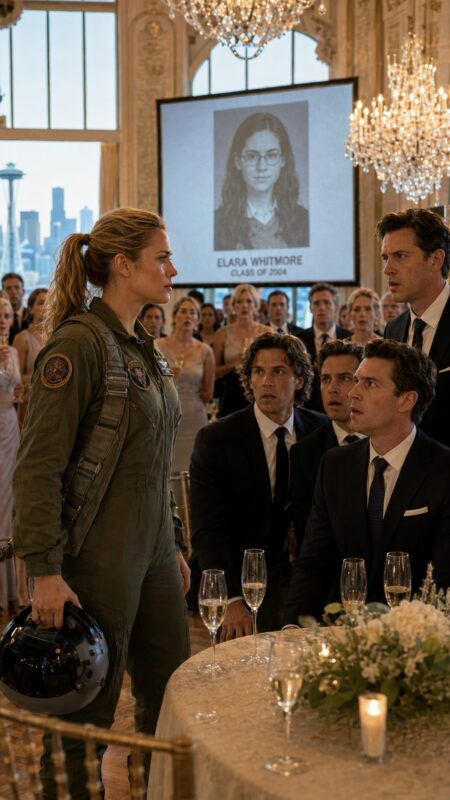
On the night of the reunion, guests stood beneath crystal chandeliers, drinking champagne and laughing over old yearbook photos. When Elara’s old picture appeared on the screen — nervous, quiet, wearing braces — the room erupted in laughter.
“I bet she comes alone,” Sawyer said.
That was when the ground began to vibrate.
Not from footsteps.
Not from cars.
From rotors.
A military Apache helicopter appeared above the property and descended toward the perfectly maintained lawn. Guests rushed to the windows as the helicopter landed with stunning precision, sending powerful gusts of wind across the grass.
Then the cockpit opened.
Elara Whitmore stepped out.
Full flight suit.
Helmet under her arm.
Straight posture.
Calm eyes.
Absolute confidence.
Two crew members followed behind her.
Inside the ballroom, silence fell.
The officer beside her spoke in a firm, clear voice:
“Please rise for Lieutenant Commander Elara Whitmore, decorated with the Navy Cross.”
Gasps moved through the room.
The girl they had invited to humiliate had arrived in a machine of war.
Elara walked into the ballroom calmly and looked directly at the four men who had tormented her for years.
No one was laughing now.
In that moment, everyone understood one thing:
She had never been the “class loser.”
But when Elara smiled and took one step toward them, one question remained in the air:
had she come only to show them who she had become… or did she have something far more powerful to say?
Continuation in the first comment… 👇
Had she come only to show them who she had become… or did she have something far more powerful to say?
Elara stopped in front of Brennan, Sawyer, Callum, and Lyle.
For ten years, she had imagined this moment in different ways. Sometimes she had pictured herself shouting. Sometimes she had imagined exposing every cruel message, every hallway insult, every lunchroom humiliation. But now that she was standing there, with all four men unable to meet her eyes, she felt no need to scream.
Power did not need volume.
She placed her helmet on a nearby table and looked at the old yearbook photo still frozen on the screen behind them.
“That girl,” Elara said quietly, “used to believe every word you said about her.”
The room remained silent.
Brennan tried to laugh, but it came out weak and broken.
“Come on, Elara,” he muttered. “We were kids.”
Elara turned to him.
“No,” she said. “You were old enough to know what cruelty was. You just thought I would stay small forever.”
No one moved.
Then she reached into the pocket of her flight suit and took out a folded photograph. It showed a teenage girl sitting alone at lunch, head down, while boys laughed behind her.
“My first commanding officer once asked me why I never quit,” Elara continued. “I told him I had already survived people who wanted me to believe I was nothing.”
Her voice did not shake.
“You four taught me pain. The Navy taught me purpose. And I turned both into something stronger than your opinion of me.”
Sawyer lowered his head.
Callum whispered, “We’re sorry.”
Elara looked at him for a long moment.
“I hope you are,” she said. “But I did not come here for an apology.”
She turned toward the rest of the room.
“I came because somewhere, someone is still being laughed at by people who think humiliation is harmless. It is not. It follows you. But it does not have to define you.”
Then she looked back at the four men.
“You invited me here to make me the joke of the night.”
She smiled gently.
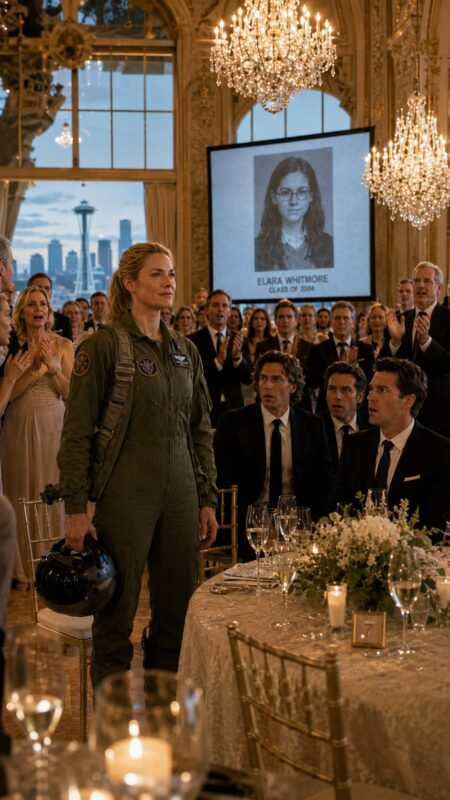
“Instead, you gave me the stage.”
No one clapped at first. Then one woman stood. Then another. Soon the entire room rose, not out of obligation, but respect.
Elara picked up her helmet and walked back toward the doors.
Behind her, the four men remained seated, pale and silent.
That night, no one remembered the old nickname.
They remembered the woman who turned it into a warning:
Never mistake someone’s silence for defeat.