For 23 Years We Ignored Him… But What We Found After He Was Gone Changed Everything 😱

LIFE STORIES

A man cleaned our yard for 23 years. Only after he was gone did we realize we knew almost nothing about him…

All those years, he was just part of the background. Every morning—with his cart and broom. Every evening—near the trash bins. We greeted him, passed by, and moved on with our lives.

His name was Arseny. A quiet, ordinary janitor. No complaints, no conversations, no attention drawn to himself. Just work—every single day, in any weather.

And then… he was gone.
I found out by accident. The yard stayed unclean for days, and someone mentioned he had passed away quietly in his small storage room. No noise. No one around him.

The funeral was simple. Only a few people came. That was the first moment I felt uncomfortable—after so many years, we didn’t even know who he really was.

A month later, I was asked to help clear out his room in the basement. They said it was just old junk.

I opened the door… and froze.

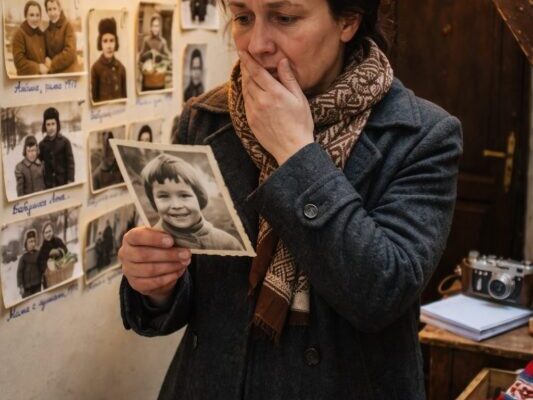
The walls were covered with photographs.

Not random pictures—real photos of people from our yard. Children, elderly neighbors, people carrying groceries, sitting on benches. And under each one—names and dates.

He knew everyone.

I found a photo of myself. One with my daughter when she was little. Moments I had completely forgotten… but he hadn’t.

In the corner was a small bed, an old camera, and a worn suitcase.

I opened it.

Inside were stacks of photographs. Hundreds. Maybe more. Each carefully labeled in his handwriting.

That’s when I realized—this quiet man we barely noticed had been preserving the story of our lives all along.

And when they said all of this should be thrown away as useless…

I couldn’t answer.

Because in that moment, I understood—this was not just a collection of photos.

It was something much more…

Read the continuation in the comments 👇

That night, I did not sleep at all.

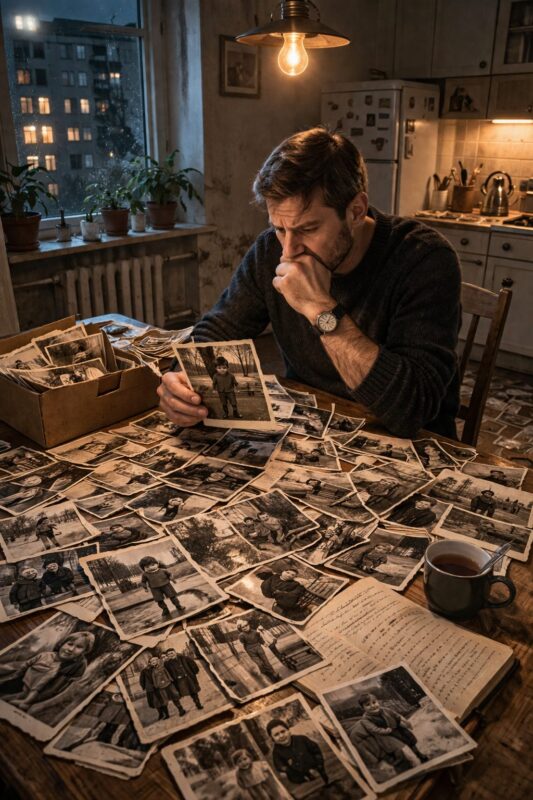
I sat in my kitchen with the photographs spread across the table and even on the floor, trying to understand what exactly I had found. For twenty-three years, the man we had barely noticed had been quietly recording our lives. Not with malice. Not out of curiosity. But with a patience so careful, so human, that it made my chest ache.

The pictures were simple. No posing, no artificial smiles. Just life as it was. A grandmother fixing her grandson’s scarf. A young couple arguing near the entrance, then laughing five minutes later. Children running through puddles. Men carrying groceries. Women sitting on benches after work, too tired even to speak. He had preserved moments we ourselves had thrown away.

Then one photograph caught my eye.

A girl of about eleven, wearing rubber boots with white stripes, smiling up at a tree. There was a gap between her front teeth. On the back, in the same neat handwriting, were only three words:

Arisha. Last year.

I had never seen her in our yard. The photo paper was different too—smoother, older, more carefully kept. I went back to his room the next morning and searched again. Under the mattress, I found a worn notebook.

Most of it was filled with short entries—dates, names, little observations:

“September 5. Dima’s first day of school. Left flowers by the door. Did not stay.”

“January 3. Klavdia Egorovna did not come outside for four days. Called for help from the payphone.”

And then, on the first page, I found the line that made everything clear:

“I could not save my own. But maybe I can keep others. At least on film. At least in memory.”

Inside the notebook were two old documents.

A death certificate for a girl named Arisha Belova.

Another for Ekaterina Belova.

His daughter. His wife.

I sat on the edge of his narrow bed with those papers in my hands and finally understood. He had come to our neighborhood carrying a loss too large to survive in any ordinary way. So he did the only thing he could: he began saving other people’s lives the only way left to him—by noticing them, by remembering them, by refusing to let their ordinary days disappear.

I went back to the building committee and told them we were not throwing anything away.

Ludmila Petrovna argued, of course. She said the room was needed, that the papers were old, that the photographs meant nothing. But for the first time in years, I did not step back. I spent the next week sorting the pictures, cleaning them, framing as many as I could.

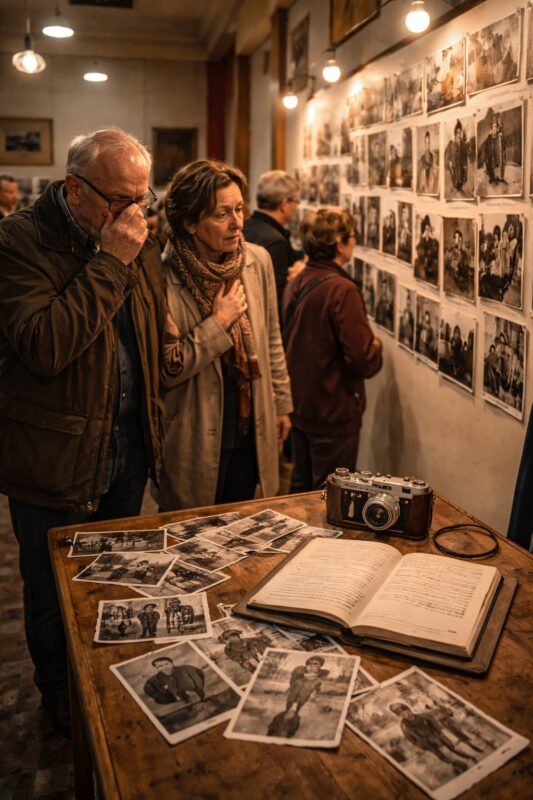
Ten days later, we opened a small exhibition in the local community hall.

I expected fifteen people.

More than a hundred came.

They walked from wall to wall in silence, finding themselves, their children, their parents, moments they had forgotten, moments they thought no one had seen. Some cried. Some laughed. Some just stood still, staring.

At the center of the room, under soft light, stood his old camera. Beside it, his notebook lay open to that first sentence.

By the end of the evening, no one called him “the janitor” anymore.

They called him by his full name.

Arseny Igorevich Belov.

And when I walked home that night through our newly cleaned yard, I looked at the dark little basement window and said out loud, for the first time in my life:

“Thank you, Arseny Igorevich.”

Because at last, after twenty-three years, we had truly seen him.

Rate article