I married a 70-year-old hospice patient to fulfill her final wish—then, after her funeral, her lawyer pulled me aside and whispered, “She didn’t choose you by chance.”
A few years ago, I began volunteering at a hospice. That was where I met Eleanor.
She was 70, terminally ill, and sharper than almost anyone I knew. The first time I entered her room, she looked at my volunteer badge and smiled.
“So they sent me the rookie.”
I laughed. “Is it that obvious?”
“You still look hopeful.”

I began visiting her twice a week. I read to her, and she told me stories about her quiet life. She had no husband, no children, and no siblings left.
One afternoon, she stared at me for a long moment.
“You have her eyes,” she said softly.
When I asked whose eyes she meant, she simply smiled and told me to keep reading.
Weeks later, Eleanor confessed something she had regretted all her life.
“I always wanted to be a bride,” she said. “Not the marriage anymore. Just the moment—the dress, the ring, someone standing there and choosing you.”
I couldn’t forget those words.
With the help of the hospice staff, we organized a small wedding. A nurse found her a white gown, another brought flowers, and I bought a simple silver ring.
On the wedding day, Eleanor stood beside me despite having used a wheelchair for weeks.
As I placed the ring on her finger, she whispered, “Look at me. Really look.”
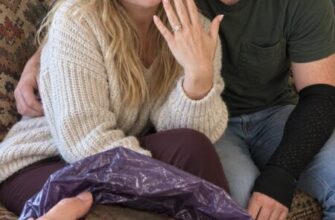
Then she raised her hand toward the camera and smiled.
“I’m a bride.”
Three weeks later, Eleanor died peacefully in her sleep.
After her quiet funeral, a man in a dark suit approached me. He introduced himself as Martin, Eleanor’s attorney, and handed me a thick sealed envelope.
“Eleanor wanted you to have this after the funeral.”
“Why me?” I asked. “The hospice assigned me to her.”
He lowered his voice.
“At first. But she didn’t choose you by chance.”
What was inside that envelope turned my whole family history upside down… Full story in the comments 👇
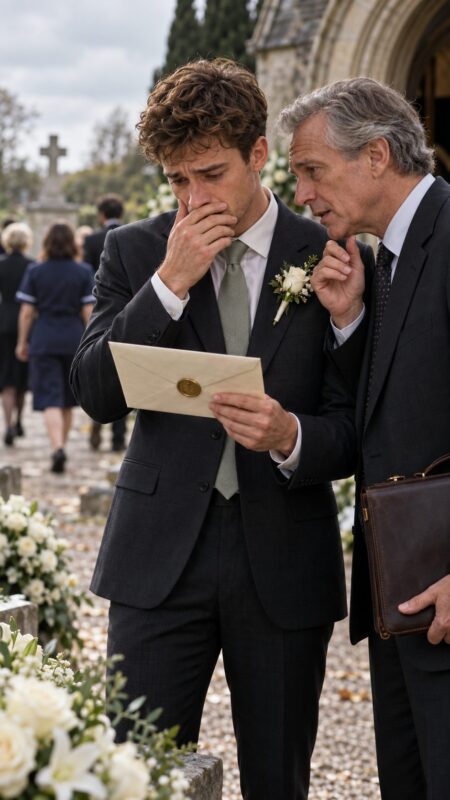
I stared at Martin, then at the envelope in my hands.
Inside was a photograph, a letter, and an old birth certificate.
The photograph stopped me first.
It showed a young Eleanor standing beside a woman I recognized immediately.
My grandmother.
For several seconds, I could barely breathe.
Martin explained that Eleanor and my grandmother had been childhood friends. They had grown up together, shared almost everything, and stayed close into adulthood.
Then something happened.
My grandmother became pregnant at nineteen.
Her family considered it a scandal.
According to Eleanor’s letter, she was the only person who helped her through it.
The birth certificate belonged to a baby girl.
My mother.
I read the mother’s name again and again.
It wasn’t my grandmother’s.
It was Eleanor’s.
My hands began to shake.
Martin waited until I looked up.
“Eleanor gave birth to your mother,” he said quietly.
The truth was complicated.
Eleanor had become pregnant young, with no support and no money. My grandmother, already married and unable to have children, offered to raise the baby as her own. The arrangement was kept secret to protect everyone involved.
Eleanor stayed away because she believed it was the kindest thing she could do.
But she never stopped watching from a distance.
She saved newspaper clippings, graduation announcements, and photographs of my mother.
Years later, she found me.
The hospice assignment had been random at first.
But after Eleanor saw my name on the volunteer list and recognized the family connection, she asked the staff if I could continue visiting her.
That was why she had said I had “her eyes.”
She meant my mother’s.
The letter ended with one final paragraph.
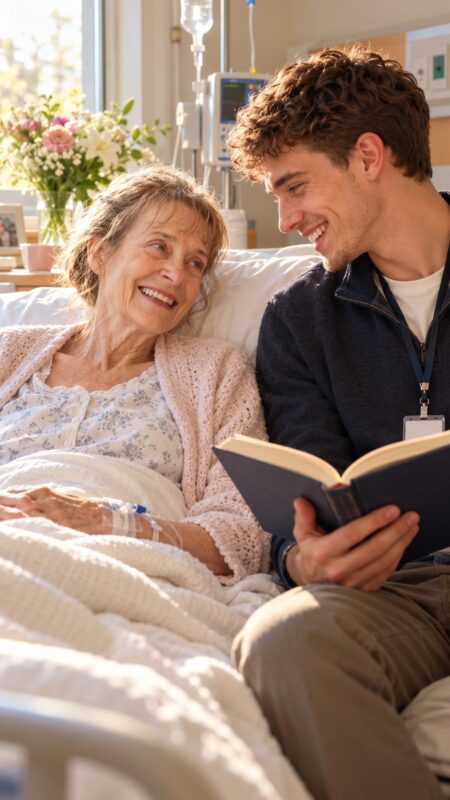
“I never had the courage to call myself your grandmother. I had already given up the right to that name. But when you offered to stand beside me and make me a bride, you gave me something I never thought I would have—a family choosing me back.”
I sat in Martin’s office and cried until I couldn’t read anymore.
There was no fortune in the envelope.
No mansion.
No dramatic inheritance.
Just the truth.
And somehow, that felt heavier than money.
I had walked into Eleanor’s room believing I was giving a dying woman one final wish.
Only after she was gone did I understand that she had spent those final weeks giving something back to me:
the missing piece of my own family.