My husband and mother-in-law threw me out into the cold autumn rain. Later, after changing my appearance, I bought their business for almost nothing. They did not recognize me…
“Get out.”
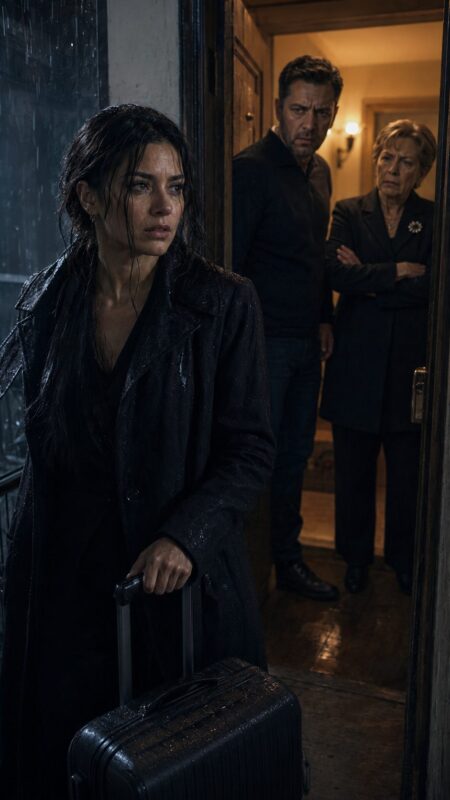
The word came from my mother-in-law, Mrs. Stefka, as the storm raged outside the windows. My husband, Dimitar, stood beside her with his head lowered, unable to look me in the eyes.
I held our five-year-old son, Misho, in my arms as he cried against my wet jacket.

“I can’t do this anymore, Elena,” Dimitar muttered. “I’m tired of poverty, tired of your savings, tired of the child crying. I’m tired of everything.”
Stefka stepped forward with a cold, merciless expression.
“He is telling you clearly,” she said. “You are a burden to him. Because of you and your family, our business is falling apart.”
She pushed me toward the open door, where the wind carried the rain inside.
“But where will we go?” I whispered. “There is a storm outside… we have no one here…”
“That is not our problem,” she replied coldly. “He deserves a better woman.”
Then Dimitar finally looked at me. His eyes were empty.
“I am leaving you, Elena. And him too,” he said, glancing at our son.
My heart shattered.
“But he is your son…”
“A burden,” Stefka hissed, throwing a packed suitcase at my feet. “We are starting a new life. Without you.”
The door slammed shut.
Misho and I were left on the landing, trembling in the cold autumn rain. I stared at the door behind which my whole life had just disappeared.
At that moment, I did not yet know about the inheritance from a distant relative that would change everything. I did not know that soon I would have enough money to make them kneel before me.
I knew only one thing:
They would bitterly regret that night. And one day, they would beg for my help.
👉 The continuation is in the comment 👇👇👇

Two weeks later, I received a letter that I almost threw away.
It was from a lawyer.
At first, I thought it was another bill, another reminder that Misho and I had nothing. We were living in a small rented room above an old bakery, sleeping under thin blankets, eating soup that the owner’s wife quietly left near our door every evening.
But when I opened the letter, my hands began to shake.
A distant aunt, whom I had cared for years ago when everyone else had forgotten her, had passed away. And she had left everything to me: her apartment, her savings, and shares in several small companies.
For the first time in weeks, I did not cry from pain.
I cried because life had finally answered.
I changed slowly. I cut my hair, dyed it darker, learned how to dress like a woman who never begged anyone to stay. I hired a financial adviser, took business courses, and discovered something interesting: Dimitar and Stefka’s company was drowning in debt. Suppliers were leaving, clients were angry, and the bank was ready to take everything.
So I waited.
When the business was offered for sale at a miserable price, I bought it through another company under a different name. Neither Dimitar nor Stefka knew who stood behind the deal.
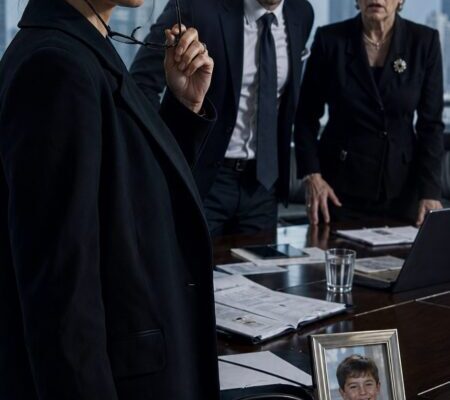
The day they came to meet the “new investor,” I entered the office in a black coat, elegant heels, and glasses. Stefka smiled politely. Dimitar looked at me for a few seconds, but there was no recognition in his eyes.
They begged for more time. Begged for mercy. Begged for help.
Then I removed my glasses.
Silence filled the room.
Stefka’s face turned gray. Dimitar stood up so quickly his chair fell behind him.
“Elena?” he whispered.
I looked at the same man who had abandoned his own child in the rain.
“Yes,” I said calmly. “The burden you threw away just bought everything you lost.”
Dimitar began to apologize, but I raised my hand.
“No. You are not sorry because you hurt us. You are sorry because I survived.”
I did not destroy them. I simply refused to save them. The company stayed mine, Misho and I moved into a warm home, and for the first time in years, my son slept without fear.
As for them, they learned the lesson too late:
Never throw away someone who knows how to rise from the storm.