When Sheikh Khalid brought a poor young woman named Lina into his palace, everyone assumed she was only another servant rescued from the streets. She arrived with one small suitcase, worn shoes, and eyes that looked as if they had already survived a lifetime of pain. No one knew where she truly came from. No one knew why the Sheikh himself had insisted she be given work inside the private wing of the estate.
But the person who hated her from the first moment was his wife, Samira.
Samira was elegant, powerful, and feared by everyone in the palace. She wore diamonds at breakfast and spoke with a smile sharp enough to cut glass. The moment she saw Lina lowering her eyes in the marble hallway, she understood one thing: her husband had brought this girl here for a reason. And whatever that reason was, Samira wanted it destroyed before anyone else discovered it.

At first, the humiliation was quiet. Samira made Lina polish the same silver tray three times. She corrected the way she walked, the way she spoke, even the way she breathed. She told the other servants not to sit with her. She made sure Lina ate alone in the back kitchen, long after everyone else had finished.
Lina never answered back.
She only lowered her head and whispered, “Yes, madam.”
That obedience made Samira even angrier.
One evening, during a grand dinner with foreign guests, Samira ordered Lina to serve the main table. The room was glowing with golden chandeliers, crystal glasses, and soft music. Sheikh Khalid sat at the head of the table, silent and unreadable.
Lina walked carefully between the guests, carrying a tray of tea. Her hands were steady, but her heart was racing. She felt Samira’s eyes following every step.
Then, just as Lina reached the Sheikh, Samira extended her foot slightly.
Lina stumbled.
The tray crashed to the marble floor.
Hot tea spilled across the expensive carpet. The room went silent. Guests turned. Servants froze. Lina dropped to her knees, trembling, trying to gather the broken cups with shaking fingers.
Samira rose slowly from her chair.
“You see?” she said coldly. “This is what happens when people forget their place.”
Lina’s face burned with shame. Tears filled her eyes, but she did not speak.
Samira stepped closer.
“A palace does not turn street girls into ladies,” she said. “It only shows everyone what they truly are.”
A few guests looked away, embarrassed. Others whispered. Sheikh Khalid’s jaw tightened, but he still said nothing.
Samira smiled, believing she had won.
Then she reached down, grabbed Lina by the wrist, and pulled her up in front of everyone.
But as Lina’s sleeve slipped back, something appeared on her skin.
A small crescent-shaped birthmark near her wrist.
Sheikh Khalid stood so suddenly that his chair struck the floor behind him.
The entire room went silent again.
His face turned pale.
Samira noticed his reaction and froze.
Lina tried to pull her sleeve down, but the Sheikh was already staring at the mark as if he had seen a ghost.
“Where did you get that?” he asked, his voice barely above a whisper.
Lina looked terrified.
“I was born with it,” she said.
The Sheikh took one step toward her.
Samira’s smile disappeared.
Because twenty years earlier, before Samira entered the palace, Sheikh Khalid had lost his first wife and newborn daughter in a desert accident. Everyone had been told the baby died with her mother.
But the Sheikh had never believed it.
And now, standing in front of him, humiliated on the marble floor, was a poor girl wearing the same birthmark his missing daughter had been born with…
What happened next?
Read the continuation in the comments. 👇
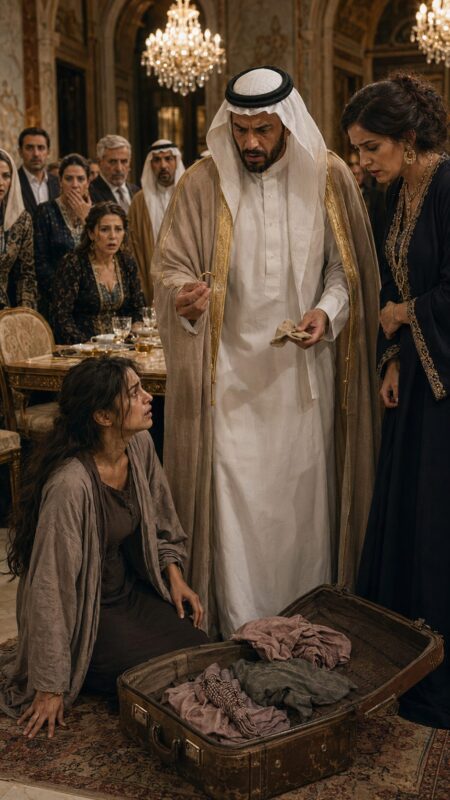
For several seconds, no one moved. The music had stopped. The guests stared at the Sheikh, then at Lina, then at Samira, whose face had turned as hard as stone.
Lina did not understand why everyone looked at her as if she had become someone else.
She only knew that her wrist hurt where Samira had grabbed her.
Sheikh Khalid slowly approached her, his eyes fixed on the crescent mark.
“What was your mother’s name?” he asked.
Lina swallowed.
“I don’t know,” she whispered. “The woman who raised me said I was found as a baby near an old road outside the city. She said I had no papers, only a small gold bracelet wrapped in cloth.”
The Sheikh’s breath caught.
“A bracelet?”
Lina nodded. “I still have it.”
Samira stepped forward quickly.
“This is absurd,” she snapped. “Many people have birthmarks. Many poor girls invent stories when they see wealth.”
Lina looked down, wounded by the words.
But Sheikh Khalid did not look at his wife. He looked at the head servant.
“Bring her suitcase.”
Samira’s eyes widened.
“Khalid, you cannot seriously—”
“Bring it,” he said again, colder this time.
The room waited in suffocating silence.
Minutes later, Lina’s small suitcase was carried into the dining hall. It looked painfully out of place against the gold, crystal, and silk. Lina knelt beside it and opened the broken lock with trembling hands.
Inside were two dresses, an old scarf, a folded photograph of the woman who raised her, and a small cloth pouch.
She handed the pouch to the Sheikh.
His hands shook as he opened it.
Inside lay a tiny gold baby bracelet, darkened by age. On the inner side, almost erased by time, was engraved one word:
Amira.
The Sheikh covered his mouth with his hand.
That had been the name of his lost daughter.
A painful sound escaped him, not quite a cry, not quite a prayer. For the first time, the powerful man everyone feared looked completely broken.
Lina stared at him, confused and frightened.
“What does it mean?” she whispered.
The Sheikh stepped closer, tears shining in his eyes.
“It means,” he said, “that you were never a servant in this house.”
Samira turned pale.
The guests began whispering, and the servants looked at one another in shock.
But the Sheikh raised his hand, and the room fell silent.
“Twenty years ago, my wife and infant daughter disappeared after an attack in the desert,” he said. “I was told they died. But my daughter had this mark. And I gave her that bracelet myself.”
Lina shook her head slowly.
“No… that cannot be true.”
“I searched for you for years,” he said. “I never stopped.”
Samira suddenly laughed, but the sound was sharp and desperate.
“How touching,” she said. “A birthmark and an old bracelet, and suddenly this girl becomes your daughter? Do you realize what people will say?”
The Sheikh turned to her.
“What they will say matters less than what you did tonight.”
Samira lifted her chin.
“I protected this family from embarrassment.”
“No,” he said. “You humiliated a girl who had done nothing to you. And if she is truly my daughter, then you humiliated the blood of this house in front of everyone.”
The words struck harder than any punishment.
Lina stepped back, overwhelmed.
“I don’t want anyone punished because of me,” she said softly. “I only came here to work.”
That sentence broke the Sheikh more than anything else.
He turned to the guests and ordered the dinner ended. Then he called his private doctor and legal adviser. Within hours, old records were opened, the bracelet was examined, and a blood test was arranged.
Samira spent the night pacing the palace, telling herself it had to be impossible.
But three days later, the truth arrived in a sealed envelope.
Lina was his daughter.
Her real name was Amira Khalid.
The palace that had treated her like a servant suddenly bowed before her, but Lina did not change. She did not demand revenge. She did not ask for diamonds, titles, or power.
She asked for only one thing.
“I want the woman who raised me to be honored,” she said. “She had nothing, but she gave me love.”
The Sheikh granted it immediately.
As for Samira, she was not thrown into the streets, as many expected. Instead, the Sheikh removed her authority over the household. No servant answered to her again. No one feared her voice in the corridors. Her punishment was not poverty.
It was silence.
The same silence she had forced on Lina.
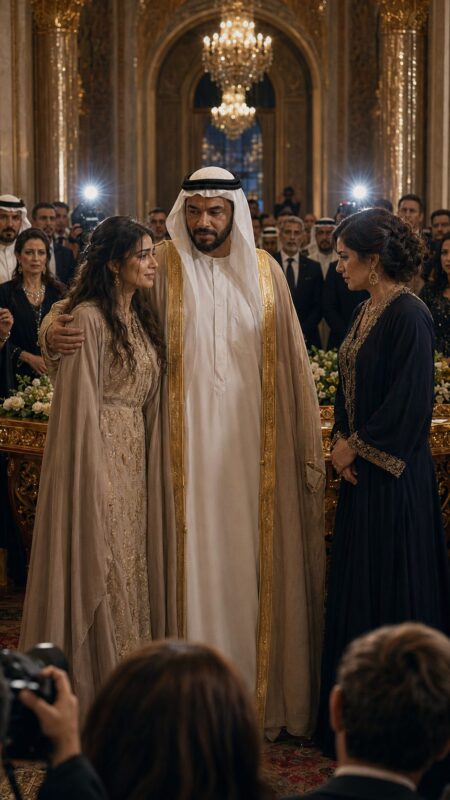
Months later, during a public charity ceremony, Lina stood beside Sheikh Khalid, not as a maid, but as his daughter. Cameras flashed. Guests bowed. Samira watched from the back, invisible for the first time in her life.
Then Lina noticed her.
For a moment, everyone waited to see if she would turn away.
Instead, Lina walked toward her and said quietly, “I forgive you. But I will never let anyone like me be humiliated in this house again.”
That day, the palace changed forever.
Because the poor girl everyone looked down on had not come to steal a place among them.
She had come home.