Two years ago, walking down that same street felt like punishment.
I was thirty-eight years old, deeply unhappy, and heavier than I had ever been. My clothes barely fit, my knees hurt constantly, and I avoided mirrors because I no longer recognized the woman staring back at me.
But the physical pain was nothing compared with the humiliation.

Every morning, I passed the same group of people outside a coffee shop near my office. They were young, attractive, confident, and cruel.
At first, they only whispered.
Then they stopped trying to hide it.
“Careful,” one man laughed as I passed. “The sidewalk might collapse.”
The women beside him covered their mouths and giggled.
Another time, one of them pointed at the salad in my hand and said loudly:
“A little late for that, don’t you think?”
I wanted to turn around and defend myself. Instead, I lowered my eyes and kept walking.
They had no idea that I had gained most of the weight after losing my mother.
She had died suddenly, and food became the only thing that quieted the emptiness inside me. I ate when I was lonely, when I was frightened, and when I could not sleep. Every cruel comment made me feel worse, and every painful evening sent me back to the kitchen.
One afternoon, their laughter followed me all the way to my apartment.
I locked the door, slid down against it, and cried until I could barely breathe.
That was the day I decided something had to change.
Not because they deserved a different version of me.
Because I deserved to live without hating myself.
I did not begin with a dangerous diet or an impossible exercise routine. I started by walking for ten minutes every morning. Then fifteen. Then thirty.
I found a therapist who helped me understand that my grief had never disappeared—it had only been buried beneath years of shame and emotional eating.
I learned to cook simple meals. I stopped punishing myself whenever I made a mistake. Some weeks I lost weight. Other weeks, nothing changed.
There were mornings when I wanted to give up.
But every time I passed that coffee shop, I remembered how small their laughter had made me feel.
Eventually, I changed my route.
Not because I was afraid of them anymore, but because I no longer wanted strangers to control my day.
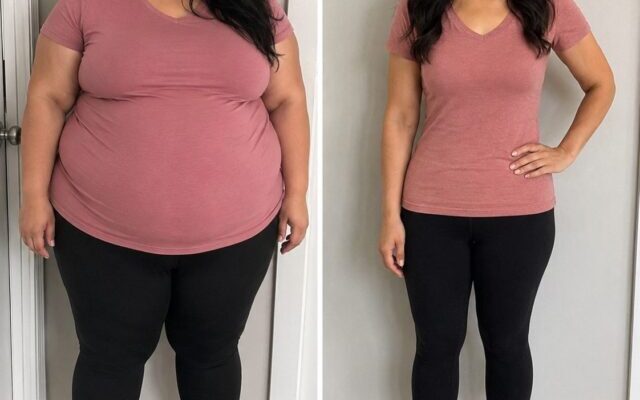
Over the next two years, I lost more than half my body weight.
Yet the greatest transformation was not visible.
I learned to stand straight.
I learned to look people in the eye.
I learned that confidence did not arrive when my body became smaller. It began the moment I stopped believing that my size determined my worth.
Then, one sunny morning, I returned to the old street.
I wore black trousers, a simple rose-colored shirt, and the same pale sneakers I had worn during my first painful walks.
At first, nobody recognized me.
I passed the coffee shop with my head held high.
Then I heard a familiar voice behind me.
“Excuse me!”
I kept walking.
“Wait! Please!”
When I turned, I saw them.
👉 Read the continuation in the comments 👇

The same man who had joked about the sidewalk was hurrying toward me. The three women who had laughed beside him followed close behind.
Their expressions were completely different now.
They smiled warmly, as if we were old friends.
“You look incredible,” one woman said. “What did you do?”
The man stared at me and shook his head.
“I cannot believe it is really you.”
Another woman stepped closer.
“We were just saying you should join us for coffee. You must tell us your secret.”
For a moment, I said nothing.
They did not seem to remember the jokes.
Or perhaps they remembered and hoped I did not.
The man smiled and added:
“You should be proud. You are finally beautiful.”
Finally.
That single word brought back every laugh, every whisper, and every evening I had spent crying behind a locked door.
I looked at each of them calmly.
Then I smiled.
“You think I became worthy of your attention because I lost weight,” I said. “But the only thing that changed today is that you can no longer see the woman you enjoyed humiliating.”
Their smiles disappeared.
Several people nearby had stopped to listen.
One of the women lowered her eyes.
“We were only joking,” she whispered.
“No,” I replied. “You were teaching a grieving woman that strangers could decide whether she deserved dignity.”
Nobody spoke.
I turned to leave, but the youngest woman suddenly called after me.
“I am sorry.”
This time, her voice did not sound playful.
I looked back and saw tears in her eyes.

The others remained silent.
I nodded once.
“I hope you mean it. And I hope the next person does not have to transform before you treat them like a human being.”
Then I walked away.
Behind me, no one laughed.
And for the first time on that street, I did not feel ashamed of the woman I had once been.
I felt proud of her.
Because she was the one who survived long enough to become me.