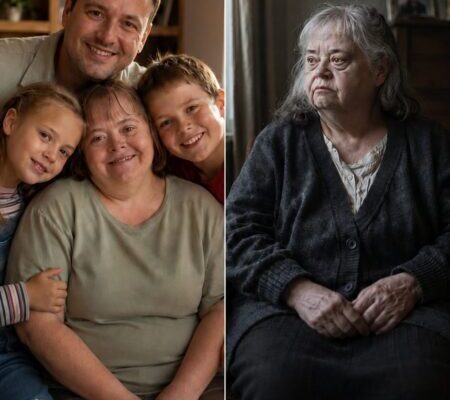
In 2005, when twenty-eight-year-old Emily married Daniel, people in their small town whispered that their happiness would never last.
Emily had Down syndrome, and cruel strangers often treated her as though she could not understand love, marriage, or motherhood. But Daniel never saw her as someone who needed to be rescued. He saw the warm, funny woman who remembered everyone’s birthday, danced while cooking dinner, and could calm him with a single smile.
Together, they built a life that surprised everyone.

They adopted two children, Sophie and Noah, filled their modest home with photographs, and created the kind of family neighbors secretly envied. Every evening, Daniel returned from work and kissed Emily in the kitchen while the children complained dramatically about how embarrassing their parents were.
For years, their home was full of laughter.
But time changed everything.
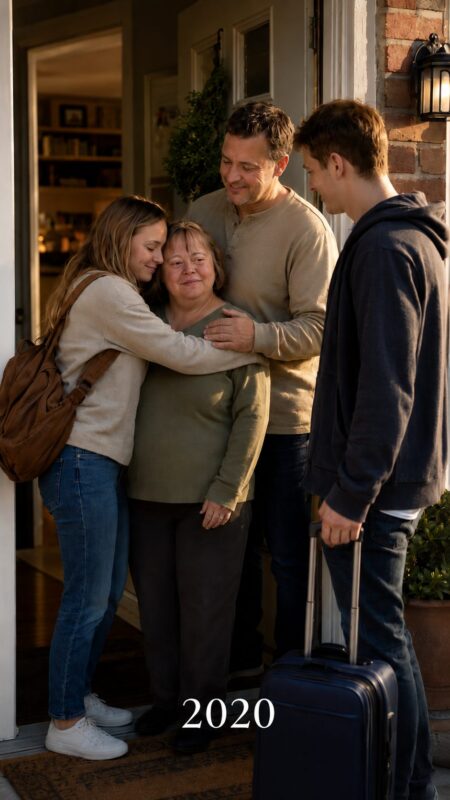
By 2030, Sophie and Noah were grown. They accepted jobs in distant cities and stood at the front door with suitcases while Emily tried to smile through her tears.
“You’ll come back for birthdays?” she asked.
“Always,” Sophie promised.
But visits slowly became less frequent.
Then Daniel became ill.
By 2045, Emily was an elderly widow living alone in the same house where her children had once chased each other through the hallways. Every morning, she placed three cups on the breakfast table before remembering there was no one left to drink from them.
On her seventieth birthday, no cards arrived.
No voices filled the hallway.
Emily sat beside an untouched cake she had bought for herself and stared at an old family photograph.
Then she noticed something behind the frame—a sealed envelope in Daniel’s handwriting.
Her hands began to tremble as she opened it and read the first sentence:
“My dearest Emily, if you are reading this alone, our children have finally discovered what we hid from them…”
Read the continuation in the comments 👇👇👇
Emily read the sentence again, barely breathing.
What had she and Daniel hidden?
She unfolded the letter.
“Years ago,” Daniel had written, “when the doctors told me I was sick, I made Sophie and Noah promise not to give up their dreams to care for us. You would have sacrificed everything to keep them close, so I asked them not to tell you how much they wanted to stay.”
Emily’s eyes filled with tears.
She remembered the day the children had left with their suitcases. She had believed they were excited to escape their small town. She had never known Sophie cried in the car for three hours or that Noah had nearly rejected his university scholarship.
Daniel’s letter continued.
“They did not leave because they loved you less. They left because I begged them to build the lives we always wanted for them. But I also asked them for one final promise: when the time was right, they would come home.”
At that exact moment, someone knocked on the front door.
Emily froze.
The knock came again.
She carefully stood, holding Daniel’s letter against her chest. When she opened the door, Sophie was standing on the porch with tears streaming down her face.
Beside her stood Noah, holding the handle of a large suitcase.
Behind them were two cars packed with boxes.
For several seconds, Emily could not speak.
“What are you doing here?” she finally whispered.
Sophie stepped forward and wrapped her arms around her mother.
“We’re not visiting, Mom.”
Noah smiled through his tears.
“We’re coming home.”
Emily stared at the boxes, confused.
Sophie explained that she had accepted a teaching position nearby. Noah’s company had allowed him to work remotely. They had spent months arranging everything in secret because they wanted to surprise her on her birthday.
But there was more.
Two children climbed out of Sophie’s car, followed by Noah’s pregnant wife. Within seconds, Emily’s silent porch was filled with grandchildren, luggage, laughter, and voices calling her “Grandma.”
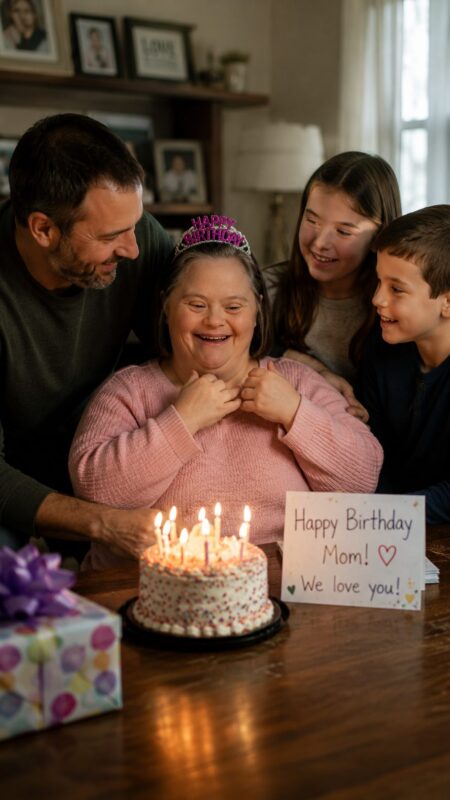
Then Noah carried in a cake.
Sophie placed a glittering birthday crown on Emily’s head.
The woman who had expected to spend the evening alone suddenly found herself surrounded by the family she thought time had taken away.
As everyone sang, Emily looked toward the framed photograph on the shelf.
For a moment, she imagined Daniel standing beside it with the same gentle smile he had worn on their wedding day.
Later that night, Sophie found her mother holding his letter.
“Dad planned this, didn’t he?” she asked.
Emily nodded.
“He always knew how to bring us together.”
Sophie rested her head on her mother’s shoulder.
“We never abandoned you, Mom. We were only trying to keep the promise we made him.”
Emily looked around the crowded room. Children were opening gifts that were not theirs. Noah was cutting uneven slices of cake. Someone had spilled juice on the tablecloth.
The house was noisy again.
Beautifully, wonderfully noisy.
For forty years, strangers had underestimated Emily. They had doubted she could become a wife, raise children, survive grief, or build a meaningful life.
But as she sat surrounded by three generations of her family, Emily understood something those strangers never had:
A family is not perfect because no one ever leaves.
A family is perfect when love always finds its way back home.