My name is Hannah Cole. I was thirty-nine years old and had served fourteen years with the Tennessee Highway Patrol when dispatch sent me to the eastern edge of Nashville on October 18.
The first caller reported a bear sitting in the road.
The second insisted it was a dog, but said something was terribly wrong.
The third claimed the animal had already been struck and refused to move.
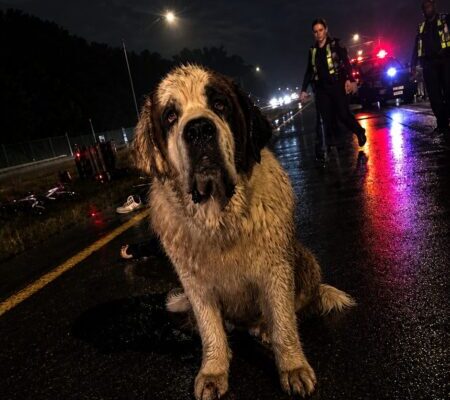
I found him beneath a broken streetlight near the Stones River overpass.

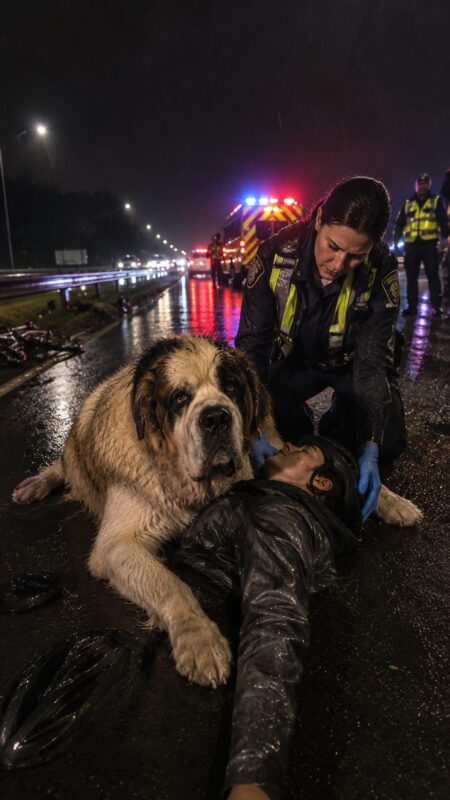
He was an enormous male Saint Bernard, broad-chested, white around the muzzle and rust-red across his back. Rain soaked his thick coat, and blood covered his right hind leg.
He sat directly in the eastbound center lane, facing three lanes of approaching traffic.
He should have run.
He did not.
A tractor-trailer changed lanes less than forty feet in front of him. The force of the passing vehicle pushed his fur across his eyes, yet he leaned forward and remained in place.
“Possible injured animal,” I told dispatch. “Shut this road down before someone dies.”
My partner, Trooper Marcus Reed, blocked the two left lanes while I closed the right. Red and blue lights reflected across the wet pavement and guardrails.
The dog looked at us.
Then he turned toward the vehicles slowing behind our cruisers.
Foam glistened around his mouth, and one eye was beginning to swell. Marcus stepped out holding a catch pole.
“Could be rabid,” he warned.
But the dog did not growl, bark or show his teeth. He simply sat with his front paws planted firmly apart, listening to every approaching engine.
I moved closer.
“Easy,” I said. “We’re stopping them.”
A pickup truck suddenly braked behind our roadblock.
The tires screamed.
The Saint Bernard tried to stand.
His injured hind leg collapsed beneath him, but he dragged himself several feet toward the sound and placed his body directly in line with the lane.
That was when I realized he was not trying to escape the highway.
He was protecting something on it.
I aimed my flashlight beyond his shoulder.
The beam caught a silver bicycle pedal near the edge line, followed by a twisted wheel against the guardrail and an overturned cargo trailer in the weeds.
Then the light crossed something pale on the pavement.
Fingers.
A woman lay motionless behind the dog.
She wore a black cycling jacket and gray pants that nearly disappeared against the wet road. Her helmet had landed in the grass, and one arm stretched toward the Saint Bernard.
The dog had positioned himself between her body and every vehicle approaching from the west.
I ran toward her.
He limped after me, refusing to let me pass until I knelt beside the woman and checked her neck.
There was a pulse.
Weak and slow, but still there.
“Send medical assistance immediately,” I told dispatch.
The Saint Bernard returned to the traffic side of the woman and sat down again.
He had two bleeding wounds, a badly injured hind leg and a torn front paw. Still, he refused to lie down.
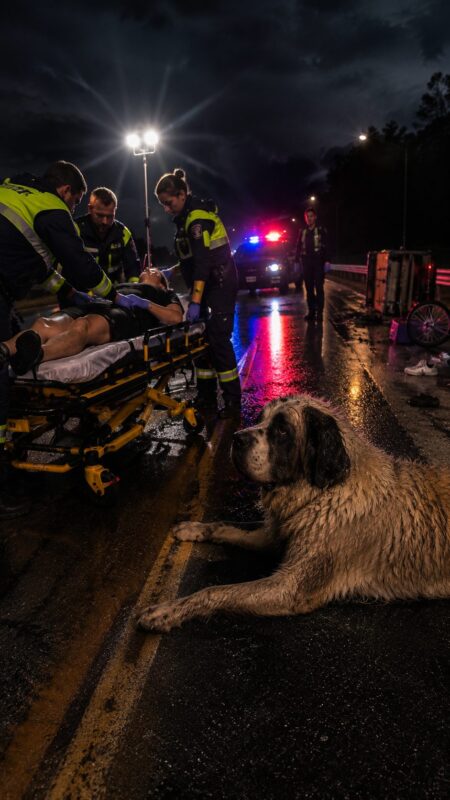
The ambulance arrived at 3:19.
Paramedics placed a collar around the woman’s neck and began treating her beneath bright portable lights. The dog watched every hand that touched her.
When they lifted the stretcher, he tried to follow.
His injured leg collapsed again.
This time, he could not stand.
He lay on the center line with his head raised, watching as the ambulance doors closed around the woman he had protected with his own body.
We had found them in time.
What none of us knew was how long he had been sitting there—or what the highway cameras would show him doing each time another vehicle came close.
If you have ever wondered what a dog might sacrifice when nobody is watching—please, read what appeared on four hours of traffic footage.
Read the continuation in the comments 👇
Four hours later, Marcus and I stood inside the highway monitoring office, watching the footage in silence.
The first camera showed the woman cycling along the shoulder at 11:46 p.m. The Saint Bernard trotted beside her, attached to the small cargo trailer behind the bicycle.
A speeding car drifted onto the shoulder.
It struck the trailer first.
The impact threw the woman onto the roadway and sent the dog rolling beneath the guardrail. The driver never stopped.
For nearly a minute, neither of them moved.
Then the Saint Bernard lifted his head.
His hind leg was already broken, but he crawled toward the woman and nudged her face repeatedly. When she did not respond, he dragged himself into the nearest traffic lane.
The next several hours were almost unbearable to watch.
Whenever headlights appeared, he stood directly between the vehicles and the woman.
Some drivers swerved.
Others slowed and continued without stopping.
One car struck his shoulder and spun him across the pavement. Still, he rose again and returned to the same position.
At 2:38 a.m., a truck came so close that its mirror brushed his fur. The dog did not move until it had passed safely around the woman.
“He wasn’t blocking traffic,” Marcus whispered.
“He was directing it.”
At the hospital, doctors identified the cyclist as Emily Carter, a thirty-two-year-old veterinary technician. She had suffered a fractured skull, internal bleeding and severe hypothermia.
Her Saint Bernard’s name was Samson.
Emily remained unconscious for three days.
Samson underwent surgery for his leg and shoulder injuries. The veterinary team feared he might never walk normally again, but every time someone opened the clinic door, he raised his head as though expecting Emily to enter.
On the fourth morning, she did.
She arrived in a wheelchair, pale and bandaged.
The moment Samson saw her, he tried to stand.
Emily lowered herself beside him and wrapped both arms around his neck.
“You stayed,” she whispered.
Samson pressed his enormous head against her chest and closed his eyes.
The driver who struck them was later identified through the traffic footage and arrested.
Months afterward, Emily and Samson returned to the same stretch of Highway 70 for a road-safety ceremony held in their honor.
Samson walked with a limp, but he walked beside her.
That night, he had not known whether anyone would come.
He had only known that the woman he loved was lying helpless behind him.
So he made himself larger than the darkness, stronger than his pain and more visible than death itself—
and remained in the road until someone finally understood what he was trying to save.