Lily hated motorcycles after the crash.
She hated engines, highways, hospital elevators, wheelchair tires, and anyone who called her lucky to be alive. Most of all, she hated mirrors.
The drunk driver who struck us survived with cuts on his forehead.
My eight-year-old daughter lost both legs above the knee.
When we returned to our small home in Joplin, Missouri, I closed the curtains to stop the neighbors from staring. Lily remained in the back bedroom, where she could pretend the world had not continued without her.

Then, every Tuesday at four, a Harley began appearing outside.
Its rider was Mason “Rook” Mercer, a fifty-two-year-old biker who lived nearby. He was tall, heavily built, covered in faded tattoos, and belonged to the Road Saints Motorcycle Club.
The club was known for charity rides, veterans’ escorts, Toy Runs, and occasional fights.
But I knew something most people did not.
Ten years earlier, a pickup truck had struck Rook’s Harley on Interstate 44. Surgeons saved his knee but amputated the lower part of his right leg. After months of rehabilitation, he learned to walk with a prosthetic and eventually rode again.
Now he wanted to meet Lily.
“She doesn’t need a biker,” I told him through the screen door.
“Probably not.”
“She needs doctors.”
“Got those?”
“Yes.”
“Then I won’t compete.”
He sat quietly in a lawn chair outside.
Lily watched through the curtains. During his second visit, she told me to make him leave. On his third, she rolled into the hallway and shouted at him herself.
Rook stood but did not approach her.
“Yes, ma’am,” he said.
Before leaving, he placed a small chrome motorcycle bell beside our mailbox.
I explained that riders sometimes gave those bells to people they wanted protected on the road.
“I’m not going on the road,” Lily replied.
Rook returned the following Tuesday anyway.
This time, he parked around the corner so she would not hear the engine. He crossed our lawn on a wooden crutch, carrying a scratched prosthetic leg beneath one arm.
“What are you doing?” I asked.
“Showing her the ugly model.”
Lily appeared behind me.
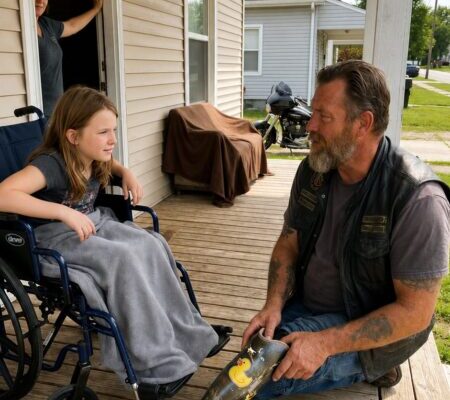
Rook sat on the lowest porch step. His empty trouser leg was pinned beneath his knee, and the prosthetic rested across his hands.
Lily studied its scratched metal and chipped foot.
“Is that yours?”
“Unless somebody switched legs at the diner.”
“Why is there a duck on it?”
“My club thought I needed something meaner.”
For the first time since the crash, Lily smiled.
Rook explained how the prosthetic attached, how its socket had once hurt, and how it had been adjusted. Lily moved closer and began asking questions.
Could he balance?
Did falling damage it?
Did people stare?
Could he still ride?
Rook never softened the truth.
Yes, people stared.
Yes, it sometimes hurt.
Yes, he had fallen.
Then he pointed toward the corner where his Harley waited.
“But I still decide where I go.”
Lily touched the yellow duck sticker and laughed when Rook made it quack.
That tiny laugh reopened our home.
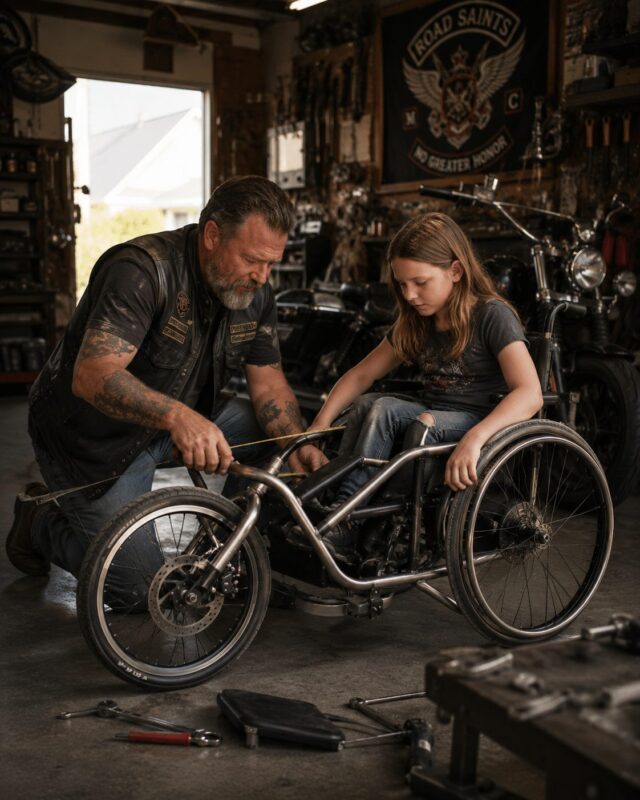
A week later, Lily sat outside. Two weeks later, she helped Rook measure the distance between her wheelchair and a custom tricycle frame hidden inside his garage.
Five years later, she would lead the Road Saints’ Christmas Toy Run while one hundred Harley engines followed her three wheels at walking speed.
Rook rode last.
Everyone believed he was protecting the group from the rear.
Nobody knew the truth.
Rook had sold the red 1986 Harley he had rebuilt with his late brother to pay for Lily’s prosthetic legs—and had made the buyer promise never to tell us.
Why did Rook surrender his irreplaceable Harley, and what was hidden inside its old saddlebag?
Read the continuation in the comments 👇
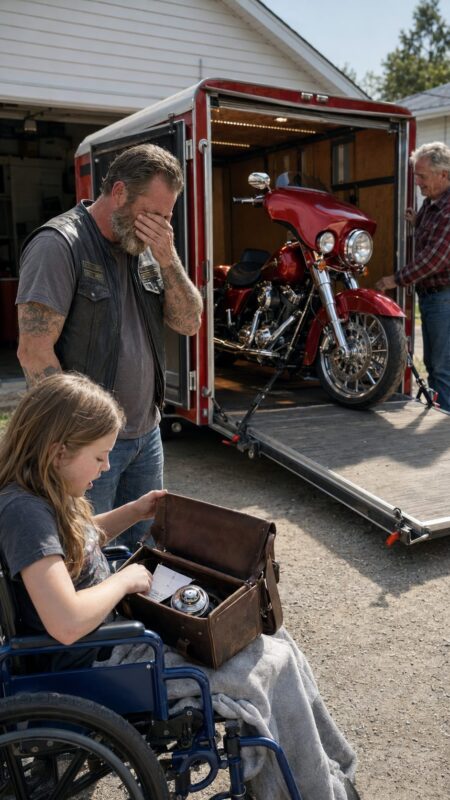
The truth emerged two weeks after the Toy Run, when an older man named Walter Briggs arrived at our house towing a covered motorcycle trailer.
Rook was in the garage adjusting Lily’s new prosthetic sockets when Walter handed me a worn leather saddlebag.
“This belongs to your daughter,” he said.
I recognized it immediately. It had once hung from the red Harley Rook had rebuilt with his brother, Daniel, before Daniel was killed overseas.
Inside were photographs of the two brothers beside the unfinished motorcycle, several rusted tools, and a sealed envelope addressed to Rook.
The letter had been written by Daniel before his final deployment.
Rook tried to take it from me, but Lily stopped him.
“You sold the motorcycle for me,” she said.
He looked away.
Walter explained that Rook had refused donations from the club. Instead, he sold the one possession he had sworn never to surrender. The Harley’s price covered the advanced prosthetic legs Lily needed, but insurance would not fully fund.
“Why?” Lily asked quietly. “You loved that motorcycle.”
Rook sat beside her and unfolded Daniel’s letter.
His brother had written that machines were never meant to remain polished inside garages. They were meant to carry people toward lives they were afraid to claim. At the bottom was one final sentence:
If this motorcycle can ever help someone stand again, let it go.
For years, Rook had believed those words referred to him.
Then he met Lily.
He sold the Harley because he realized Daniel had not been writing about a machine. He had been writing about purpose.
Walter had purchased it, but when he discovered why Rook was selling, he secretly contacted the Road Saints. Together, they restored the motorcycle once more.
He opened the trailer.
The red Harley stood inside, gleaming beneath the garage lights.
The club had bought it back.
Rook covered his face with both hands.
Lily rolled toward the motorcycle and opened the second saddlebag. Inside was her first chrome road bell, the one Rook had left beside our mailbox years earlier.
Attached to it was a new note:
You said you were never going back on the road. We are glad you were wrong.
Months later, Lily took her first steps on her new prosthetic legs while Rook stood beside her, holding out one scarred hand.
She fell twice.
Each time, she laughed and rose again.
Rook had sacrificed the motorcycle because he wanted Lily to understand what he had once learned himself:
Losing part of your body could change the way you traveled—
but it did not get to decide where your life would go.