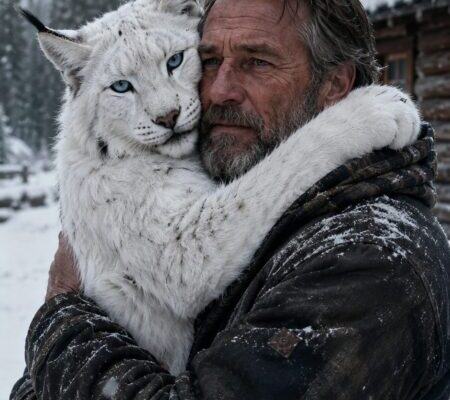
The first time Ghost wrapped his paws around my neck, his claws tore through my coat and left four deep wounds across my back.
The last time, every claw remained hidden.
Between those moments were five years of blood, patience, loneliness, and a friendship the State of Alaska eventually declared illegal.

My name is Caleb Rowan. I was fifty-four when I discovered the rare white lynx kitten beneath his dead mother in the wilderness north of Denali.
I had spent twenty-seven years as a wildland firefighter, jumping from airplanes into burning forests and carrying injured men through exploding trees. Yet after my wife, Rebecca, died of cancer, silence frightened me more than fire ever had.
I moved into an isolated log cabin, built furniture, repaired hunting sleds, and avoided people whenever possible.
Then, during a January blizzard, with the temperature at twenty-two below zero, I heard a desperate cry coming from a rocky slope.
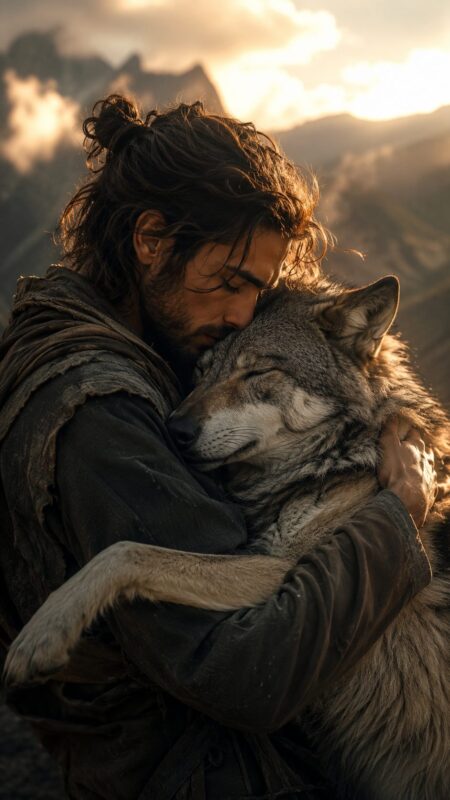
A female Canada lynx lay half buried beneath the snow. She was dead. Pressed against her frozen body was a trembling kitten barely larger than my two hands.
He was almost entirely white, except for his dark ear tufts and enormous blue eyes.
I knew I was supposed to contact Fish and Game and wait for trained officers, but help was hours away. The kitten would not survive that long.
“Not today,” I whispered, placing him inside my parka against my chest.
During the three-hour drive to Fairbanks, I kept one hand beneath my coat to make sure he was still breathing.
Dr. Natalie Brooks confirmed that he had pneumonia, severe dehydration, and almost no body fat.
“He’s a Canada lynx, Caleb,” she warned. “You cannot raise a wild predator in your kitchen.”
“Then save him before we argue about where he lives.”
She treated him and instructed me to minimize contact so he could remain wild.
I managed that for three nights.
On the third night, Ghost screamed inside his crate until he could barely breathe. When I opened the door, he climbed beneath my chin and fell asleep.
After that, distance became impossible.
Ghost destroyed half my cabin before he was six months old. He dismantled Rebecca’s antique clock, opened the refrigerator, dragged raw venison beneath the couch, and climbed anything that could support him.
My hands looked as though I had fought with barbed wire.
Still, he waited outside my bedroom every morning and slept beneath my workbench every evening.
By autumn, he weighed thirty pounds. I built him a reinforced outdoor habitat with trees, climbing platforms, heated shelter, and double-entry gates.
But instead of becoming independent, Ghost created a ritual.
Every evening at 5:30, he waited on the highest platform. The moment I entered, he launched himself toward my chest.
He was not attacking. He wanted to be held.
But lynxes do not embrace like humans.
They grab.
The first time, his claws sliced through my jacket. When I shouted, he panicked and clung even harder. Natalie needed eleven stitches to close the wounds.
“You cannot keep doing this,” she told me.
“He doesn’t understand.”
“Then teach him.”
So I did.
Wearing padded wildfire gear, I entered the enclosure every evening. Whenever Ghost jumped, I said one word.
“Gentle.”
If his claws appeared, I turned away and gave him no attention. If he touched me without gripping, I remained beside him.
For months, he struggled to control his instincts.
Then one evening, I entered wearing only a heavy flannel coat.
Ghost jumped from the platform and stopped two feet away. He rose onto his hind legs, trembling with concentration.
I opened my arms.
He placed both paws on my shoulders.
Every claw remained hidden.
Then he pressed his face against my neck and began to purr like a diesel engine.
I buried my face in his white fur and cried.
“Good boy, Ghost.”
That became our secret—until a delivery driver photographed us.
By the next morning, the picture was on Facebook. Within days, newspapers were calling me the “Lynx Whisperer of Denali.”
Then a black SUV appeared in my driveway.
Wildlife Officer Daniel Hayes inspected Ghost’s habitat, reviewed my temporary rehabilitation permit, and watched him follow me along the fence.
“You’ve done more for this animal than most people would,” Hayes admitted.
“Then we don’t have a problem.”
“We do. He is habituated to humans and cannot be released.”
Hayes handed me an official notice.
I had thirty days to transfer Ghost to a licensed sanctuary or zoological facility.
“What happens if no one accepts him?” I asked.
Hayes looked toward Ghost and remained silent.
He did not need to answer.
If I could not find Ghost a legal home within thirty days, the state would return—
and kill the only living creature still waiting for me every evening.
Read the continuation in the comments 👇
For the next twenty-nine days, I called every licensed sanctuary in Alaska, Canada, and the northern United States.
Some never answered.
Others said they had no space, no funding, or no legal authority to accept a human-habituated lynx.
Each rejection felt like another door closing around Ghost.
He seemed to sense something was wrong. He stopped waiting on the highest platform and began sleeping beside the enclosure gate, watching the cabin as though he feared I might disappear.
On the final evening, I entered his habitat and sat in the snow.
“I’m sorry,” I whispered.
Ghost approached slowly, placed his paws on my shoulders, and held me without using his claws.
That was when headlights appeared between the trees.
Officer Hayes stepped from the black SUV, accompanied by two other men carrying equipment cases. My stomach tightened.
“You’re early,” I said.
“We’re not here to take him,” Hayes replied.
He handed me a folder.
Inside was a permanent wildlife-care license issued under a newly approved educational conservation program. My cabin and Ghost’s enclosure had been registered as a restricted rehabilitation facility.
I stared at the papers, unable to understand.
Hayes looked embarrassed.
“The photograph caused more trouble than either of us expected,” he explained. “But it also reached someone important.”
A wildlife biologist at the University of Alaska had seen the image and contacted the department. She argued that Ghost’s unusual coloring, behavior, and history made him valuable for non-public research into genetic variation and human habituation in lynx populations.
The program came with strict conditions.
Ghost could never roam freely.
No visitors could touch him.
The enclosure would be inspected regularly.
And I would have to complete professional wildlife-handling training.
I would not own him.
Legally, Ghost would belong to the state.
But he could remain with me for the rest of his life.
My knees nearly gave way.
“Why didn’t you tell me sooner?” I asked.
“Because until this afternoon, I didn’t know whether the approval would come through.”
Behind the fence, Ghost began pacing and chirping.
Hayes opened the gate and nodded toward him.
“I think someone is waiting for you.”
Ghost leaped from the platform the moment I entered.
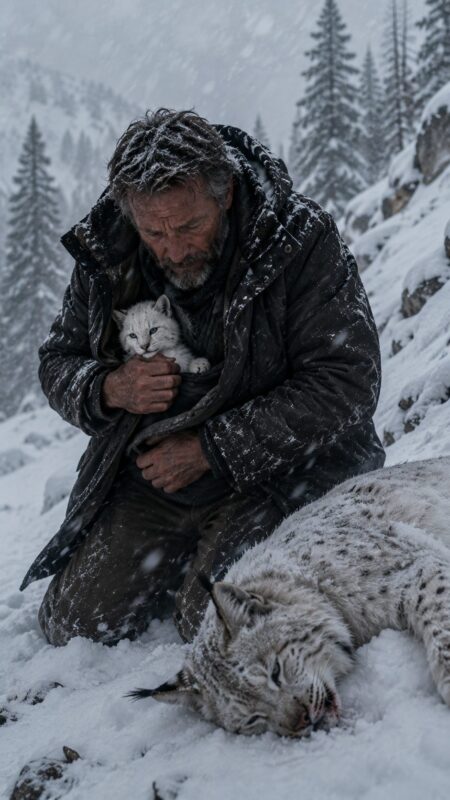
His paws landed gently on my shoulders, every claw hidden. He pressed his face against my neck and purred while I held him beneath the falling snow.
The state had not saved Ghost because he was tame.
And I had not saved him because he was rare.
We had saved each other because, years earlier, two broken creatures had met in a blizzard—and neither had been willing to leave the other behind.